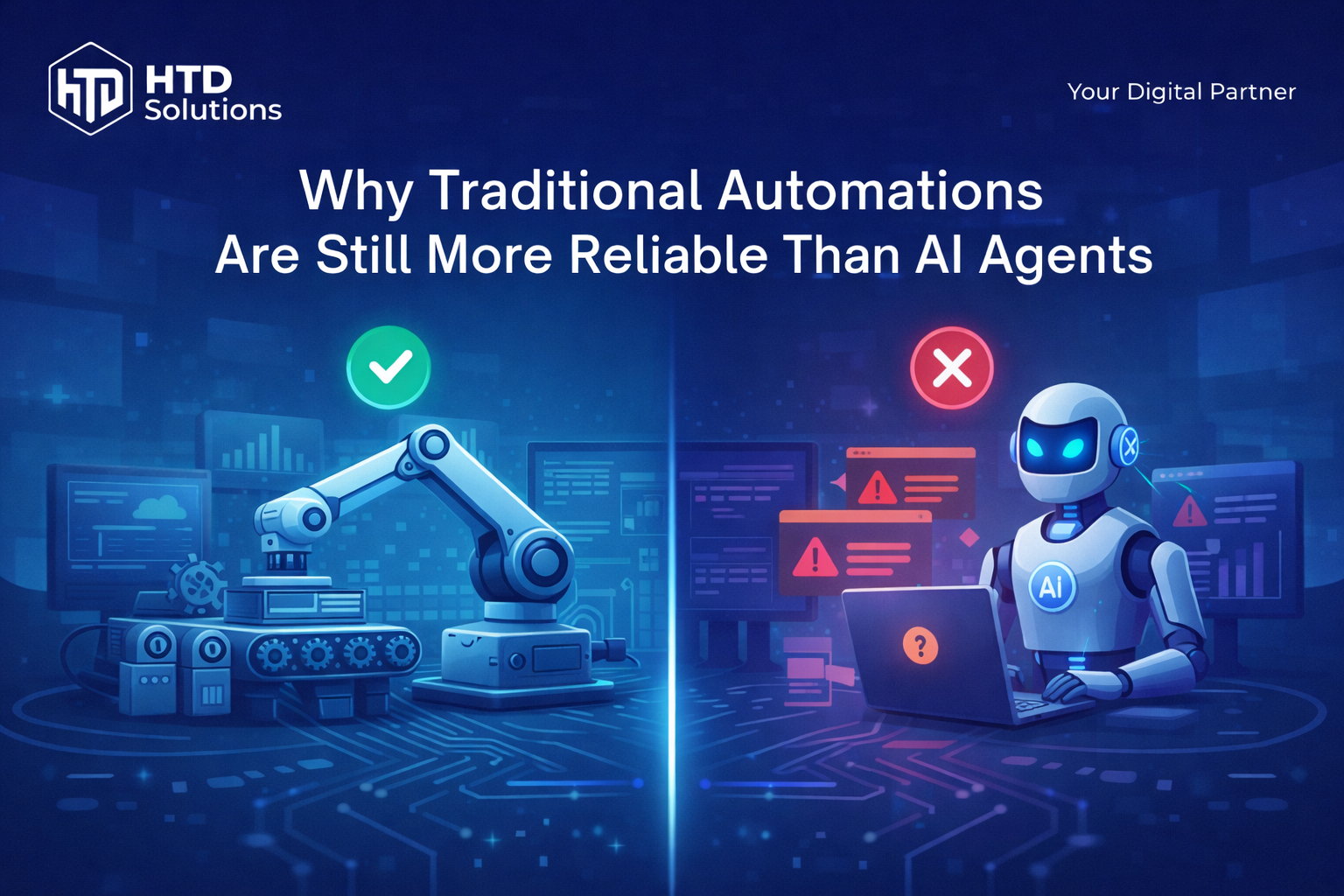
AI agents are the hottest trend in business technology. Every LinkedIn post promises they will replace your entire back office. But here is what nobody is saying: for most business tasks, traditional automations are faster, cheaper, and far more reliable.
The best automation strategy is not 'AI everywhere.' It is knowing exactly where deterministic workflows outperform probabilistic agents, and combining both for maximum impact.
This guide compares traditional automations (Zapier, n8n, Make, custom code) with AI agents (GPT-4, Claude, custom LLM agents) across eight critical dimensions. You will learn where each excels, where they fail, and how the smartest businesses combine them.
Table of Contents
Quick Answer
The Quick Truth
Traditional automations win on predictability, cost, speed, testability, and compliance. AI agents win on unstructured data, creative tasks, and adaptability. The best approach combines both.
The Quick Truth
Traditional automations win on predictability, cost, speed, testability, and compliance. AI agents win on unstructured data, creative tasks, and adaptability. The best approach combines both.
Start Here
Automate your rule-based processes first. Add AI agents only for tasks that genuinely require language understanding or creative judgment. Most businesses are better served by solid automations than flashy AI.
Start Here
Automate your rule-based processes first. Add AI agents only for tasks that genuinely require language understanding or creative judgment. Most businesses are better served by solid automations than flashy AI.
Do not fall for the hype. 70-80% of business automation needs are best solved with deterministic workflows. AI agents add real value for the remaining 20-30% where unstructured data and judgment matter. Build the reliable foundation first, then add intelligence where it counts.
The AI Agent Hype vs. Reality
AI agents are powerful. They are also unpredictable, expensive at scale, and impossible to fully audit. Before you replace your Zapier workflows with GPT-4, understand what you are trading.
What the Hype Says
- "AI agents will replace all your workflows"
- "Just describe what you want in plain English"
- "No more coding or complex setups needed"
- "AI handles everything autonomously"
- "Traditional automations are outdated"
What Reality Shows
- AI agents complement automations, they do not replace them
- Prompts need engineering, testing, and iteration
- LLMs hallucinate; critical tasks need guardrails
- Token costs scale linearly with usage
- DSGVO concerns with data sent to US providers
The Core Difference
Traditional automations are deterministic: same input, same output, every time. AI agents are probabilistic: they generate plausible responses, but outcomes can vary between runs. For business-critical processes that need 100% reliability, deterministic beats probabilistic.
Head-to-Head: Automations vs. AI Agents
Eight dimensions that matter for business automation. Score is out of 5. Higher is better.
Predictability
Automation WinsSame input always produces same output. Fully deterministic.
Outputs can vary between runs. Temperature settings help but do not eliminate variance.
Cost per Execution
Automation WinsFractions of a cent per run. Fixed monthly plans available.
Token-based pricing adds up fast. Complex tasks cost $0.01-0.50+ each.
Speed
Automation WinsMilliseconds to seconds. No model inference needed.
Seconds to minutes per task. API latency and reasoning chains add delays.
Testability
Automation WinsEasy to write unit tests. Every branch is auditable.
Testing non-deterministic output is hard. Evaluation suites help but are never exhaustive.
Error Handling
Automation WinsExplicit error branches. You define every fallback.
Agents can hallucinate errors or swallow them silently. Guardrails needed.
Handling Unstructured Data
AI Agent WinsNeeds structured inputs. Regex and parsers for edge cases.
Shines with messy emails, images, natural language, PDFs.
Adaptability
AI Agent WinsChange requires editing the workflow. New rules = new code.
Adapts to new patterns via prompts. Handles novel inputs without code changes.
Compliance & Audit Trail
Automation WinsEvery step logged. Deterministic = fully auditable.
Reasoning is opaque. Hard to explain decisions to regulators.
Score: Traditional Automations win 6 out of 8 dimensions. AI Agents win on unstructured data and adaptability.
6 Tasks Where Traditional Automations Win
These are real business processes where deterministic workflows outperform AI agents in speed, cost, and reliability.
Invoice Processing
Extract data from structured invoices, match to purchase orders, route for approval, post to accounting. Rules are fixed, volumes are high, errors are costly.
Why automation wins: Zero tolerance for hallucinated numbers. A misrouted invoice costs more than the agent saves.
CRM Lead Routing
Assign leads by territory, company size, and source. Trigger follow-up sequences. Alert sales reps. Update status fields.
Why automation wins: Routing rules rarely change and must execute in seconds, not the 5-10 seconds an agent needs to "think."
E-Commerce Order Fulfillment
Sync inventory, generate shipping labels, send tracking emails, update order status. Thousands of orders per day.
Why automation wins: High volume, zero ambiguity. An agent that "improvises" a shipping label is a liability.
Scheduled Reports
Pull KPIs from databases, format into PDF or Slack message, distribute at 07:00 daily. No interpretation needed.
Why automation wins: Reporting needs accuracy. AI summary of numbers may omit or round incorrectly.
Compliance Checks
Validate form submissions against checklists. Flag missing fields, expired documents, or policy violations.
Why automation wins: Regulators want deterministic logic, not "the AI thought it was fine." DSGVO auditors agree.
Employee Onboarding
Create accounts, assign equipment, send welcome emails, schedule training. Same checklist every time.
Why automation wins: Forgetting one step has real consequences. A workflow never forgets step 7 of 12.
3 Tasks Where AI Agents Genuinely Shine
We are not anti-AI. These are legitimate use cases where agents outperform traditional workflows.
Customer Email Triage
Read unstructured emails, classify intent, draft replies, escalate edge cases to humans.
Why AI wins: Emails are messy. Regex fails at "I want to cancel... wait, actually change my address." LLMs handle nuance.
Content Repurposing
Turn a blog post into social media snippets, email excerpts, video scripts, and ad copy.
Why AI wins: Creative tasks require language understanding. Automations cannot write a compelling LinkedIn hook.
Document Analysis
Summarize 50-page contracts. Extract clauses. Compare terms across vendors.
Why AI wins: Unstructured text at scale. No automation can "understand" a legal paragraph.
The Hybrid Approach: Best of Both Worlds
The smartest businesses do not choose one or the other. They combine deterministic automations with AI agents in a single pipeline.
1. Smart Invoice Processing
OCR extracts fields, validation rules check amounts, workflow routes to approver.
AI handles exceptions: unclear line items, handwritten notes, non-standard formats.
95% processed automatically, 5% get AI-assisted human review.
2. Customer Support Pipeline
Ticket created, classified by keywords, SLA timer starts, auto-reply sent.
AI drafts personalized response, detects sentiment, suggests priority override.
70% resolved without human intervention. CSAT scores improve 15%.
3. Sales Lead Qualification
CRM scores lead by firmographics, triggers email sequence, assigns to rep.
AI enriches lead data, analyzes website behavior, writes personalized intro.
Reps spend time on qualified leads only. Conversion rate up 25%.
Decision Framework: Automation or AI Agent?
Use this checklist for every process you want to automate. Count where each column checks true.
| Question | Automation | AI Agent |
|---|---|---|
| Is the process rule-based with clear if/then logic? | ||
| Does it handle structured, consistent data? | ||
| Do you need 100% reproducible results? | ||
| Is volume high (100+ executions/day)? | ||
| Must it comply with strict regulations? | ||
| Does it involve unstructured text or images? | ||
| Does it require creative or subjective judgment? | ||
| Must it adapt to unpredictable input formats? | ||
| Does it need natural language understanding? | ||
| Is the "good enough" threshold acceptable (90-95%)? |
More green checks? Use a traditional automation. You will get faster setup, lower cost, and bulletproof reliability.
More purple checks? An AI agent adds genuine value. Pair it with automation guardrails for production safety.
(FAQs) Frequently Asked Questions
Need Help Choosing the Right Automation Strategy?
We build both traditional automations and AI-powered workflows for Austrian businesses. Get an honest assessment of what your processes actually need, no hype, just results.