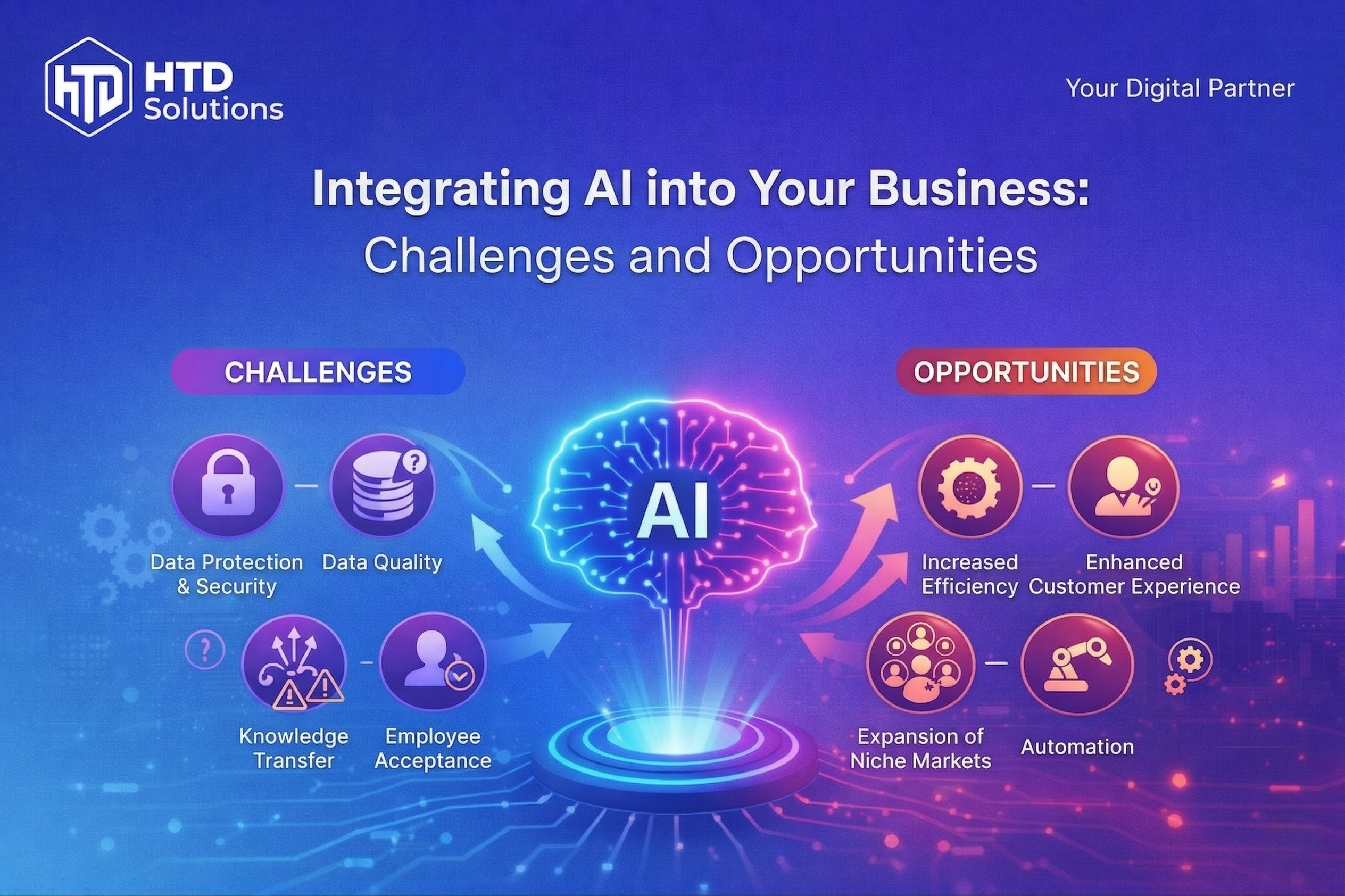
Every business leader is hearing the same message: integrate AI or fall behind. But between the hype and the reality lies a complex landscape of genuine challenges and transformative opportunities. The businesses that succeed are not those that rush into AI. They are the ones that approach it strategically.
AI integration is not a technology project. It is a business transformation that requires clear strategy, quality data, the right partners, and realistic expectations.
This guide cuts through the noise. We cover the six biggest challenges Austrian businesses face when integrating AI, the six most impactful opportunities it creates, and a practical three-phase roadmap to get started. Whether you are a 10-person startup or a 500-employee enterprise, these principles apply.
Table of Contents
Quick Answer
The Reality Check
AI integration fails most often because of poor data quality, misaligned expectations, and lack of clear use cases. The technology works. The challenge is implementation.
The Reality Check
AI integration fails most often because of poor data quality, misaligned expectations, and lack of clear use cases. The technology works. The challenge is implementation.
The Opportunity
Businesses that integrate AI strategically see 20-30% efficiency gains, 30-50% lower support costs, and measurably better customer experiences. The ROI is real when the approach is right.
The Opportunity
Businesses that integrate AI strategically see 20-30% efficiency gains, 30-50% lower support costs, and measurably better customer experiences. The ROI is real when the approach is right.
Do not try to do everything at once. Start with one high-impact use case, prove the ROI with a pilot project, then scale systematically. The biggest mistake is going too big too fast. The second biggest mistake is waiting too long to start.
6 Real Challenges of AI Integration
These are the obstacles that stop AI projects cold. Understanding them upfront is the difference between a successful implementation and a costly failure.
Data Quality and Readiness
AI is only as good as its data. Most businesses have fragmented, inconsistent, or incomplete datasets across multiple systems. Cleaning and unifying that data before AI can use it is often the biggest hidden cost.
Key insight: Companies that skip data preparation waste 60-80% of their AI budget on failed projects.
Talent and Skills Gap
Finding people who understand both AI technology and your business domain is difficult. Austria has a growing tech talent pool, but AI specialists remain in high demand and command premium salaries.
Key insight: Austrian SMEs increasingly partner with agencies rather than hiring full-time AI engineers.
Integration with Existing Systems
Your CRM, ERP, accounting software, and website were not built with AI in mind. Integrating AI tools into legacy systems requires middleware, API development, and careful data mapping.
Key insight: Integration complexity is the #1 reason AI projects go over budget and over time.
DSGVO and Data Privacy
Austrian businesses must comply with strict EU data privacy regulations. Sending customer data to US-based AI providers raises legal questions. Data residency, consent management, and processing agreements are mandatory.
Key insight: Non-compliance can result in fines up to 4% of annual revenue. Privacy-first design is not optional.
Managing Expectations
Executives expect AI to deliver instant results. Reality: meaningful AI projects take 3-6 months to show ROI. Misaligned expectations lead to premature project cancellations and wasted investment.
Key insight: Setting realistic timelines and measurable KPIs from day one prevents disappointment.
Cost and ROI Uncertainty
AI implementation costs range from a few thousand euros for simple automations to six figures for custom models. Without clear use cases, businesses struggle to justify the investment and measure returns.
Key insight: Start small with a pilot project that has clear metrics. Prove value, then scale.
The Common Thread
Every challenge above shares one root cause: lack of preparation. Businesses that invest time in data audits, stakeholder alignment, and realistic planning before writing a single line of code succeed at dramatically higher rates. The technology is the easy part. The strategy is what separates winners from failures.
6 Opportunities AI Creates for Your Business
Beyond the hype, these are the proven use cases where AI delivers measurable business impact for companies of all sizes.
Automated Customer Service
AI chatbots handle 60-80% of customer inquiries without human intervention. Smart routing sends complex cases to the right agent with full context.
Business impact: Reduce support costs by 30-50% while improving response times from hours to seconds.
Predictive Analytics
AI analyzes historical data to forecast demand, identify churn risks, and spot market trends before competitors. From sales forecasting to inventory optimization.
Business impact: Businesses using predictive analytics report 20-25% better decision accuracy.
Process Automation at Scale
Beyond simple rule-based automation: AI handles document processing, invoice matching, data extraction from unstructured sources, and intelligent workflow routing.
Business impact: Employees spend 40% less time on repetitive tasks, freeing them for strategic work.
Personalized Marketing
AI segments audiences, predicts purchase behavior, generates personalized content, and optimizes ad spend in real-time. Every customer gets a tailored experience.
Business impact: Personalized campaigns deliver 5-8x higher ROI than generic mass marketing.
Quality Control and Monitoring
Computer vision and anomaly detection identify defects, monitor processes, and flag issues before they become costly problems. From manufacturing to software deployment.
Business impact: Catch 95%+ of defects automatically, reducing quality-related costs by up to 40%.
Competitive Differentiation
Businesses that adopt AI effectively create sustainable advantages: faster delivery, better customer experiences, smarter pricing, and more efficient operations.
Business impact: Early AI adopters in the DACH region report 15-30% higher growth rates.
The Pattern: The highest-ROI AI implementations are not the most complex. They are the ones that solve a specific, measurable problem for a clear business audience.
3-Phase Implementation Roadmap
A proven framework for introducing AI into your business without the chaos. Each phase builds on the previous one.
Phase 1: Assess and Prioritize
A prioritized list of AI opportunities ranked by impact and feasibility.
Phase 2: Pilot Project
A working proof of concept with measured results and lessons learned.
Phase 3: Scale and Optimize
AI integrated into daily operations with measurable business impact.
Build vs. Buy vs. Partner: The Decision Matrix
Three approaches to getting AI into your business. Each has trade-offs. The right choice depends on your resources, timeline, and needs.
Time to Deploy
3-12 months. Custom development takes time but fits exactly.
1-4 weeks. SaaS tools are ready to go with standard features.
4-12 weeks. Tailored solutions with agency expertise.
Customization
Fully custom. Every feature designed for your specific needs.
Limited. You work within the platform constraints.
High. Agency adapts solutions to your business requirements.
Upfront Cost
High. Developer salaries, infrastructure, training data.
Low. Monthly subscription, predictable expenses.
Medium. Project-based pricing with clear deliverables.
Maintenance
Your responsibility. Model updates, bug fixes, scaling.
Vendor handles everything. Updates included in subscription.
Shared. Agency maintains, you monitor and provide feedback.
Data Control
Full control. Data never leaves your infrastructure.
Vendor-dependent. Check data processing agreements carefully.
Negotiable. Good agencies prioritize your data sovereignty.
DSGVO Compliance
Full control but full responsibility. You must ensure compliance.
Varies widely. US-based SaaS may have data residency issues.
Agency handles compliance. Local partners know Austrian law.
Build when you need full control, have in-house talent, and the AI is your core competitive advantage.
Buy SaaS when speed matters, the use case is standard, and you want predictable monthly costs.
Partner when you need customization, lack in-house expertise, and want DSGVO compliance handled.
The Austrian AI Landscape in 2025
Austria is well-positioned for AI adoption, but has unique considerations compared to larger markets.
Strengths
- Strong R&D ecosystem with TU Wien, JKU Linz, and ISTA leading AI research
- Government funding via FFG and aws for AI and digitalization projects
- High data privacy standards (DSGVO) build customer trust
- Growing tech talent pool in Vienna, Graz, and Linz
- Strong manufacturing sector ready for AI-powered optimization
Challenges Specific to Austria
- Smaller talent pool than Berlin, London, or Amsterdam for AI specialists
- Conservative business culture may slow adoption in traditional industries
- Strict DSGVO enforcement limits some US-based AI tool usage
- German-language AI models lag behind English-language alternatives
- SME-dominated economy means smaller budgets for AI experimentation
The Austrian Advantage
Austria's strict data privacy culture is actually a competitive advantage. Businesses that integrate AI while maintaining DSGVO compliance build deeper customer trust than competitors who cut corners. In the long run, privacy-first AI creates stronger, more sustainable business relationships.
(FAQs) Frequently Asked Questions
Ready to Explore AI for Your Business?
We help Austrian businesses identify the right AI opportunities, build pilot projects, and scale what works. No hype. Just practical AI solutions that deliver measurable results.