Digital transformation is no longer a buzzword. It is the operating reality for every business that wants to survive the next decade. But with so many technologies competing for attention and budget, the real question is: which trends actually matter for your business, and which are hype?
The companies that thrive in the next 5 years will not be the ones that adopted the most technology. They will be the ones that adopted the right technology at the right time, aligned with a clear business strategy.
This guide cuts through the noise. We identify seven megatrends that will reshape how businesses operate from 2026 to 2031, assess your readiness for each, and provide a practical timeline for adoption. Whether you run a 10-person startup in Vienna or a 500-employee manufacturer in Linz, these shifts will affect you. The only question is whether you will lead or follow.
Table of Contents
Quick Answer
The Landscape
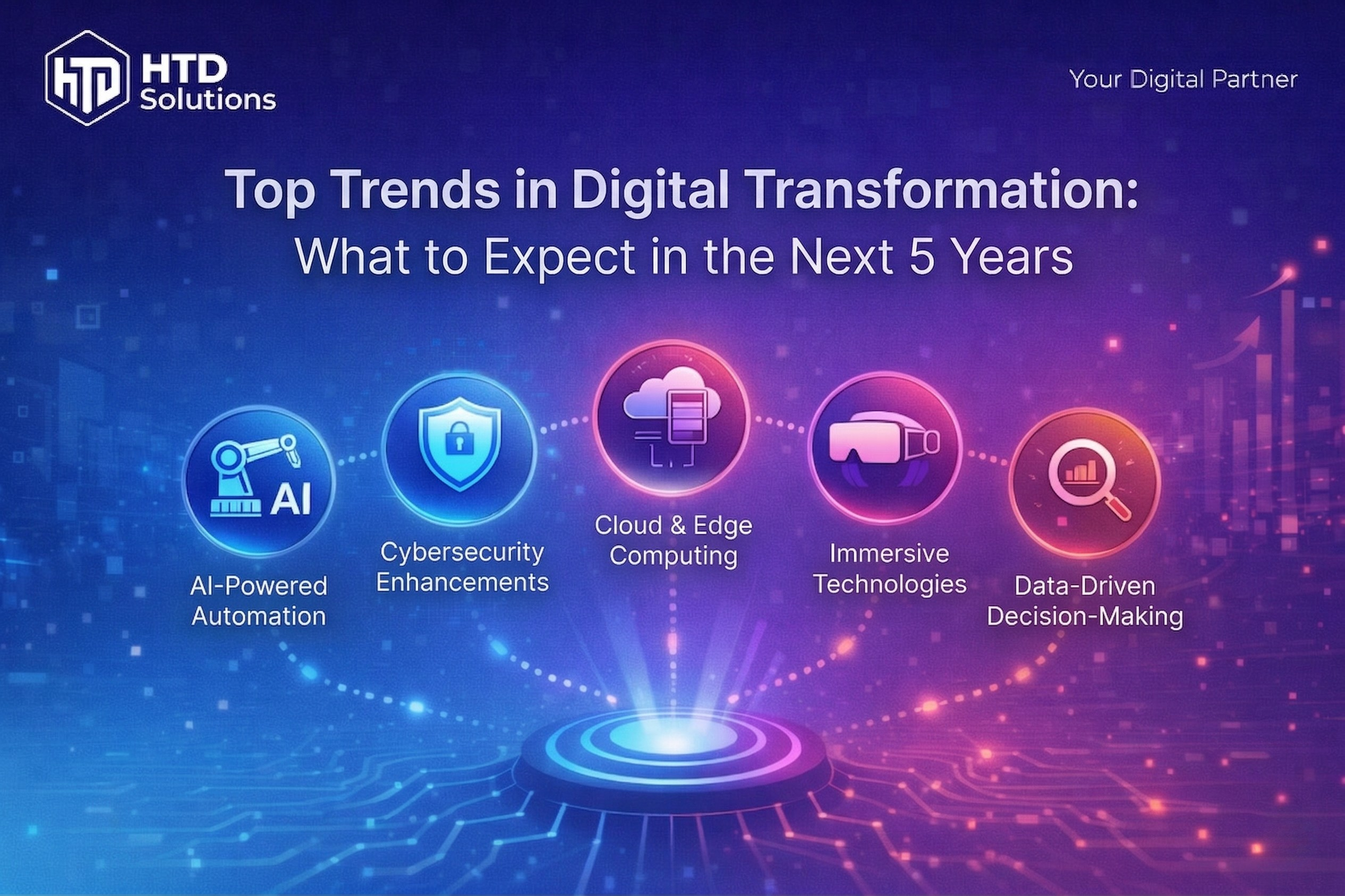
Seven interconnected megatrends are converging: AI-first operations, hyper-automation, composable architecture, privacy-first systems, green technology, edge computing, and workforce transformation. They are not independent. They reinforce each other.
The Landscape
Seven interconnected megatrends are converging: AI-first operations, hyper-automation, composable architecture, privacy-first systems, green technology, edge computing, and workforce transformation. They are not independent. They reinforce each other.
The Opportunity
Early adopters in the DACH region report 20-40% efficiency gains. But 70% of digital transformation initiatives still fail. The difference is not budget. It is strategy, sequencing, and change management.
The Opportunity
Early adopters in the DACH region report 20-40% efficiency gains. But 70% of digital transformation initiatives still fail. The difference is not budget. It is strategy, sequencing, and change management.
Do not try to adopt all seven trends simultaneously. Start with AI automation and composable architecture for immediate ROI. Build privacy-first foundations. Then layer in edge computing and sustainability as regulations require. Strategy beats speed. Always.
7 Trends Shaping the Next 5 Years
These are not predictions. They are trajectories already in motion. Understanding them now gives you time to prepare before they become urgent.
AI-First Business Operations
AI moves from isolated tools to the operating system of entire businesses. Decision-making, customer interactions, supply chain logistics, and financial forecasting all run through AI layers. This is not about chatbots. It is about AI embedded in every process.
What Changes
- Automated document processing replaces 70% of manual data entry
- AI-driven pricing adjusts in real time based on demand, costs, and competition
- Predictive maintenance prevents equipment failures before they happen
- Smart CRM systems that prioritize leads and suggest next-best actions
Audit your current processes. Identify the 3 most repetitive, data-heavy tasks. These are your first AI candidates.
Hyper-Automation and Intelligent Workflows
Simple rule-based automations evolve into intelligent orchestration. AI agents coordinate between systems, handle exceptions, and learn from outcomes. The goal: end-to-end process automation that adapts without human intervention.
What Changes
- Multi-step workflows that span CRM, ERP, email, and accounting
- AI handles exceptions that previously required manual review
- Self-optimizing workflows that improve their own efficiency over time
- Natural language commands replace complex automation configuration
Document your top 10 business workflows in detail. You cannot automate what you do not understand.
Composable Architecture and API-First Design
Monolithic software is replaced by modular, composable systems. Businesses assemble their tech stack from best-of-breed components connected via APIs. Need a new payment provider? Swap it. New CRM? Plug it in. No more vendor lock-in.
What Changes
- Headless CMS, headless commerce, and headless everything
- API marketplaces where businesses browse and connect services like apps
- Low-Code and No-Code platforms for non-developers to build integrations
- Microservices architecture becomes the default for new projects
Evaluate your current tech stack for API capabilities. If a tool does not have an API, plan its replacement.
Privacy-First and Sovereign Data Systems
The EU AI Act, evolving DSGVO enforcement, and growing consumer awareness push businesses toward full data sovereignty. Companies that treat privacy as a feature rather than a compliance burden gain competitive advantage. Third-party cookies are dead. First-party data is gold.
What Changes
- EU-hosted cloud services and data residency become standard requirements
- Zero-party data strategies replace third-party tracking
- Privacy-preserving AI techniques (federated learning, differential privacy)
- Automated compliance monitoring and reporting tools emerge
Map where all your data lives. Ensure every third-party tool has a valid data processing agreement.
Sustainable and Green Technology
Environmental regulations and customer expectations push digital sustainability to the forefront. Energy-efficient cloud computing, green hosting, carbon-aware software design, and digital sustainability reporting become business requirements, not nice-to-haves.
What Changes
- Carbon footprint reporting for digital operations becomes mandatory in EU
- Green hosting and carbon-neutral cloud providers gain market share
- Energy-efficient code and optimized resource usage become development standards
- Digital product passports required for e-commerce under EU regulations
Measure your current digital carbon footprint. Choose hosting providers with renewable energy certifications.
Ambient Intelligence and Edge Computing
Computing moves from centralized cloud to the edge: closer to where data is generated. IoT sensors, smart devices, and on-premise AI models process data locally for faster responses and better privacy. The office, factory, and retail store become intelligent environments.
What Changes
- Real-time processing at the edge eliminates cloud latency
- On-device AI models ensure data never leaves the premises
- Smart sensors in retail, logistics, and manufacturing enable real-time optimization
- Voice and gesture interfaces supplement traditional screens
Identify processes where latency matters. Evaluate which AI models could run locally instead of in the cloud.
Skills-First Workforce Transformation
Digital transformation is ultimately a people transformation. The biggest bottleneck is not technology, it is the skills gap. Companies that invest in continuous upskilling, AI literacy, and change management outperform those that only buy tools.
What Changes
- AI literacy programs become standard onboarding for all roles
- Hybrid teams of humans and AI agents collaborate on complex tasks
- Continuous micro-learning replaces annual training programs
- Digital fluency becomes as important as language skills in hiring
Assess your team's current digital skills. Create a 12-month upskilling roadmap focused on AI and automation literacy.
Digital Readiness Assessment
Before adopting new trends, assess where you stand today. Score yourself across five critical dimensions.
Data Readiness
- Is your data clean, structured, and accessible?
- Do you have a single source of truth for customer data?
- Can your systems exchange data via APIs?
Technology Stack
- Are your core systems cloud-based or cloud-ready?
- Do your tools have modern APIs for integration?
- Can you add or replace components without breaking everything?
Team Skills
- Does your team understand basic automation concepts?
- Do you have someone who can manage digital projects?
- Is there openness to learning new tools and methods?
Strategy Alignment
- Do you have a digital roadmap for the next 2-3 years?
- Are investments tied to measurable business outcomes?
- Does leadership champion digital initiatives?
Security and Compliance
- Are you DSGVO-compliant across all systems?
- Do you have a data breach response plan?
- Are vendor agreements up to date with EU requirements?
Scoring: If you answered "Yes" to fewer than half the questions in any dimension, that is your starting point. Fix foundations before chasing trends.
Your Adoption Timeline
A phased approach to digital transformation. Each phase builds on the previous one. Do not skip ahead.
Now: Quick Wins (0-6 Months)
Immediate efficiency gains and a clear picture of your digital baseline.
Next: Foundation Building (6-18 Months)
A connected, intelligent infrastructure ready for advanced capabilities.
Future: Competitive Advantage (18-36 Months)
A fully digitally transformed organization with sustainable competitive advantages.
The Austrian Perspective
Digital transformation in Austria has unique characteristics compared to larger markets. Understanding these gives you a strategic edge.
Austrian Advantages
- Strong government funding: FFG and aws offer grants for digitalization and AI projects
- High trust economy: Austrian businesses benefit from DSGVO compliance as a selling point
- Manufacturing excellence: Industrie 4.0 adoption in Austrian factories leads Central Europe
- Education pipeline: TU Wien, JKU Linz, and TU Graz produce strong technical graduates
- EU market access: Digital solutions built for Austrian compliance scale across the EU
Challenges to Navigate
- SME-dominated economy: Smaller budgets mean transformation must be incremental and ROI-driven
- Conservative adoption culture: Decision cycles are longer. Build compelling business cases.
- Talent competition: Vienna, Graz, and Linz compete for the same digital talent pool
- German-language AI gap: German NLP models still lag behind English capabilities
- Legacy infrastructure: Many Austrian businesses still run on systems built 10-20 years ago
The Austrian Opportunity
Austria's combination of strong privacy regulation, government funding, and manufacturing expertise creates a unique opportunity. Businesses that digitalize with DSGVO compliance built in can sell across the entire EU with confidence. The Austrian approach of "quality over speed" actually works in your favor for building sustainable digital systems that last.
5 Pitfalls to Avoid
70% of digital transformation initiatives fail. These are the patterns that kill them.
Technology Before Strategy
Buying tools without understanding which processes need fixing. Technology should follow a clear business objective, not the other way around.
Big Bang Over Incremental
Trying to transform everything at once. Successful digital transformation happens in phases. Quick wins build momentum and fund the next iteration.
Ignoring Change Management
Focusing on systems and forgetting the people. Without training, communication, and leadership buy-in, even the best technology fails at adoption.
Vendor Lock-In Blindness
Choosing proprietary platforms that trap your data and workflows. Always evaluate exit strategies and data portability before signing a contract.
Measuring Activity Instead of Outcomes
Tracking how many tools you deployed instead of the business outcomes they produced. Focus on revenue impact, time saved, and customer satisfaction.
The pattern: Every failed transformation shares the same root cause: prioritizing technology over strategy. Start with "what business outcome do we need?" not "what tool should we buy?"
(FAQs) Frequently Asked Questions
Ready to Future-Proof Your Business?
We help Austrian businesses navigate digital transformation with practical strategies, not hype. From quick automation wins to long-term architecture planning, we build digital systems that grow with you.