If your AWS, Azure, or GCP bill in Austria grew faster than revenue, this guide is your short path to savings. Below are 12 high-impact levers—with concrete, numeric examples and an Austria lens (data residency, regions, VAT) so you can execute this week.
Most Austrian SMEs overspend 25–55% on cloud infrastructure without realizing it. The fix? Six proven tactics you can deploy this week.
Cloud spend is a business decision, not a developer hobby. Treat it like margin.
Table of Contents
Quick Answer
Fast wins
Rightsizing, off-hours shutdown, storage tiering, commitments (SPs/Reservations/CUDs), Spot/Preemptible, log/egress controls
Fast wins
Rightsizing, off-hours shutdown, storage tiering, commitments (SPs/Reservations/CUDs), Spot/Preemptible, log/egress controls
Typical savings
25–55% blended savings within 30–60 days on mid-size estates
Typical savings
25–55% blended savings within 30–60 days on mid-size estates
Austria region
Azure Austria East (Vienna) now available for local data residency; AWS/GCP use Frankfurt/Zurich/Netherlands
Austria region
Azure Austria East (Vienna) now available for local data residency; AWS/GCP use Frankfurt/Zurich/Netherlands
Most Austrian SMEs overspend 25–55% on cloud costs. The 12 quick wins: rightsizing (15–40% savings), reserved instances (up to 72% off), auto-scaling, removing orphaned resources, storage lifecycle policies, cheaper regions, CDN, database optimization. Start with billing analysis, then tackle top 3 waste areas. Typical payback: immediate. Use Azure Austria East (Vienna) for local data residency.
The 12 Quick Wins
1. Rightsize VMs and containers
What it is: Downsize instance families and limits to real usage (p95 CPU/memory).
Example: If 30% of your fleet runs at ≤25% CPU, a one-size drop typically saves 20–40% on those nodes.
How: AWS Compute Optimizer, Azure Advisor, GCP Recommender; align Kubernetes requests/limits with p95 not p50.
2. Off-hours shutdown for non-prod
What it is: Turn off Dev/Test nightly and on weekends.
Example: Run only Mon–Fri, 09:00–18:00 → 55 hours used / 168 total = 67% potential savings on those environments.
3. Commit to usage (SPs/Reservations/CUDs)
What it is: 1–3 year commitments for steady workloads.
Example: AWS/Azure up to 72%; GCP CUDs ~46–57% vs on-demand.
How: Start with 30–50% of steady baseline, then layer.
4. Use Spot/Preemptible for flexible work
What it is: Interruptible VMs for CI, batch, stateless services.
Example: Up to 90% off list on AWS/Azure; 60–80% typical on GCP.
5. Move to ARM where feasible
What it is: Migrate from x86 to Graviton (AWS), Ampere (Azure), or Tau T2A (GCP).
Example: ~40–50% better price-performance on common scale-out workloads.
6. Storage tiering & lifecycle
What it is: Push infrequent data to cooler tiers (S3 Standard-IA/Glacier, Azure Cool/Archive, GCS Nearline/Coldline/Archive).
Example: Long-lived, rarely accessed data often sees 50–90% lower at-rest cost; check retrieval fees.
7. Control egress & cross-region chatter
What it is: Keep services co-located; cache via CDN; avoid chatty cross-AZ/region designs.
Example: Heavily distributed microservices can waste thousands €/mo on data transfer; consolidation + CDN lowers bill and latency.
8. Right-license & downsize managed databases
What it is: Reduce instance sizes, storage IOPS caps, and replicas; use serverless/autoscaling tiers.
Example: 15–40% savings typical with no functional impact.
9. Clean idle load balancers, IPs, disks, snapshots
What it is: Audit for unattached volumes, aged snapshots, idle LBs/addresses.
Example: Often 5–10% of total bill in neglected estates.
10. Logging & metrics retention policy
What it is: Cap retention (e.g., 30–90 days) and sample high-cardinality metrics.
Example: 20–60% reduction on observability line items without losing incident context.
11. Autoscaling with realistic targets
What it is: Scale on p95 latency/SLO not raw CPU, and enable predictive scaling where it's stable.
Example: 15–35% for spiky workloads.
12. FinOps guardrails & chargeback
What it is: Budgets, anomaly alerts, and cost allocation (tags/labels) with team chargeback.
Example: Prevents regression; typically 10–15% sustained savings from behavior change.
Austria-specific notes
Data residency: Azure Austria East (Vienna) is live with three AZs; use for low-latency, in-country storage and compliance needs.
Closest regions (if not Azure AT-East): AWS Frankfurt (eu-central-1); GCP Frankfurt/Zurich/Netherlands.
VAT & accounting: Track spend by cost center for Vorsteuer and audits; export usage with precise SKUs.
Two mini case studies
Case A — Vienna SaaS (AWS): 120 c5.large + RDS + S3
Actions: 35% rightsizing, 40% baseline into 1-year Compute SPs, Spot for CI, S3 IA + lifecycle.
Result: −41% total in 6 weeks (compute −50%, storage −28%).
Case B — Salzburg Retail (Azure): VMSS + Azure SQL + Blob
Actions: Off-hours Dev/Test, 3-year RIs on steady API tier, switch parts to Ampere, Blob Cool/Archive, CDN.
Result: −38% total in 8 weeks.
A 7-day rollout plan
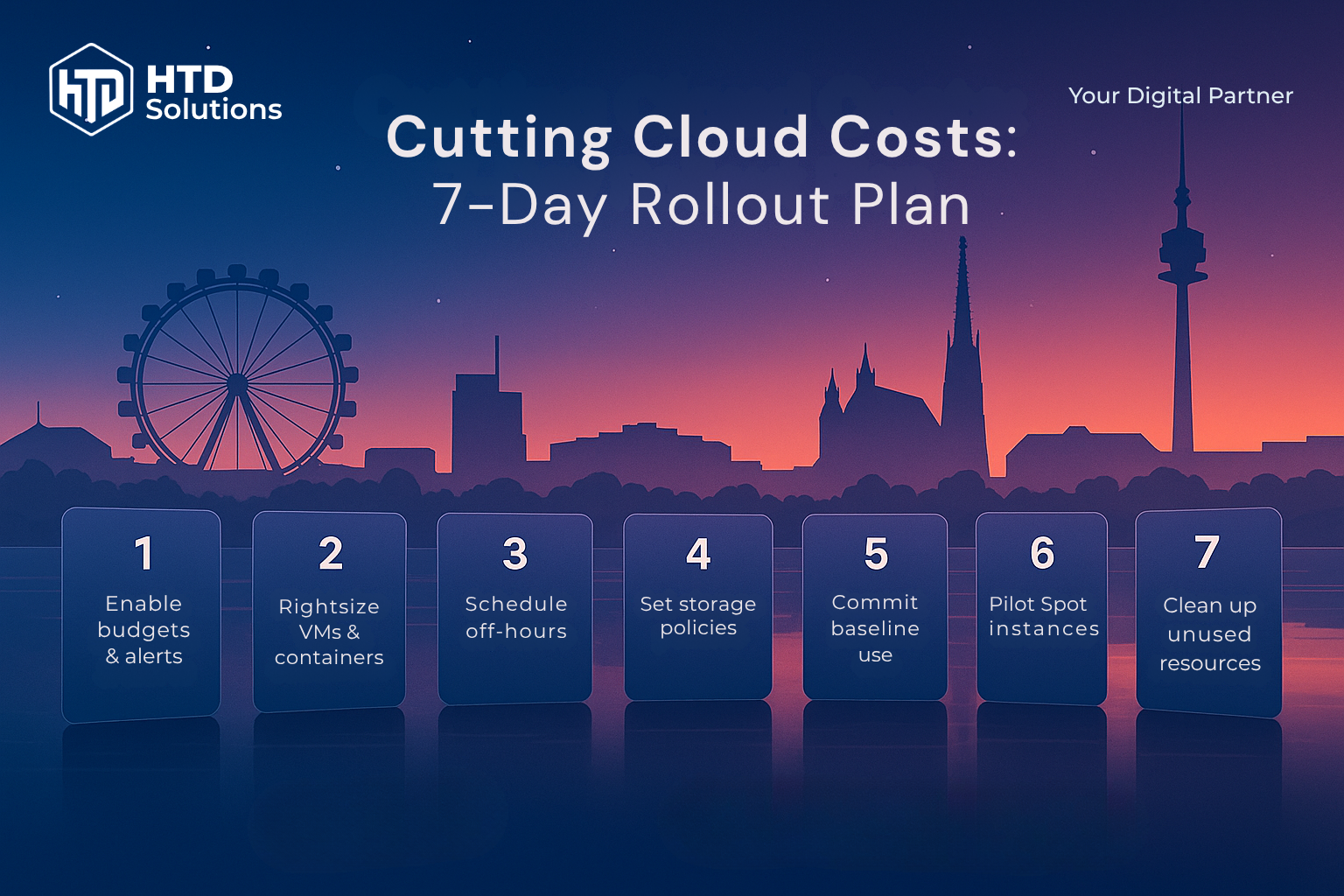
A simple, focused plan to get started this week.
Enable org-level budgets + anomaly alerts; fix tagging minimum (env, app, owner).
Rightsize VMs/AKS/EKS/GKE with p95 data.
Turn on off-hours schedules for Dev/Test.
Storage lifecycle rules; expire logs >90 days.
Commit 30–50% of steady baseline (1-year).
Pilot Spot/Preemptible for CI/batch.
Remove idle LBs/IPs/disks; publish a cost scorecard.
Sources
- • AWS Savings Plans up to 72%: AWS Documentation
- • Azure Reserved VMs up to 72%: Microsoft Learn
- • GCP CUDs ~46–57%: Google Cloud
- • Spot/Preemptible up to 90%: AWS EC2 Spot
- • Azure Austria East launch: Data Center Dynamics
- • Nearby AWS/GCP EU regions: AWS Global Infrastructure
- • Storage tiering (S3, Blob, GCS): AWS S3 Pricing
- • ARM price-performance (AWS/Azure): AWS Graviton
(FAQs) Frequently Asked Questions
Want us to do a 90-minute FinOps Quick Audit?
Get a one-page savings plan with numbers tailored to your cloud infrastructure. Our team will analyze your current setup and provide concrete recommendations.